

Some golf courses reveal their personality through a famous architect’s name or a clubhouse filled with championship memorabilia. Big Run Golf Club makes its strongest impression through the land itself.
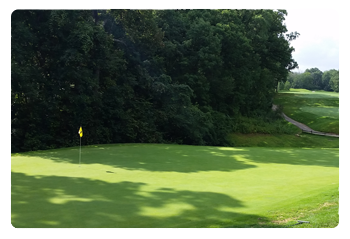
Mature oaks, substantial elevation changes, water hazards and demanding greens give this Lockport public course a character that stands apart from flatter suburban layouts. Here, selecting a club involves more than reading a yardage marker, and reaching the putting surface does not necessarily mean the difficult work is finished.
Opened in 1930, Big Run also holds a meaningful place in Illinois tournament history. It hosted the first Illinois State Public Links Championship, adding a competitive milestone to a story now approaching a century.
A Golf Course With Roots in 1930

Big Run Golf Club
The Chicago District Golf Association lists Big Run’s founding year as 1930, placing its beginnings near the end of the period commonly associated with golf architecture’s Golden Age. Its longevity connects today’s public golfers with an earlier generation of Chicago-area course development.
The CDGA identifies the architects as Muehlenford and Sneed. Spellings vary among published accounts, while some commercial directories list Harry B. Smead instead. The CDGA attribution provides the clearest basis for describing the original design, although the conflicting records deserve acknowledgment.
What remains unmistakable is the course’s setting, featuring hundreds of mature oaks, five lakes and Long Run Creek, with water affecting eight holes. Those features help explain why Big Run’s appeal extends beyond its age: the landscape gives golfers something distinctive to navigate and remember.
Where the Terrain Shapes the Round
Big Run’s hills are central to the experience and are reminiscent of nearby Crystal Tree Golf and Country Club in Orland Park. Elevation changes alter perspective, complicate club selection and introduce another variable into shots that might appear straightforward on a scorecard.
A downhill tee shot invites confidence, but the approach that follows may demand a different calculation. An uphill target can make the front of a green harder to judge. Uneven lies ask golfers to account for balance and ball flight before deciding how aggressively to attack.
That combination rewards a thoughtful approach. The useful question is often where to leave the next shot. A drive that finishes in a comfortable position can be more valuable than one that travels farther but creates an awkward stance or angle.
The mature trees reinforce that emphasis on placement. Around a course like this, recovery golf becomes easier when a player accepts the available opening rather than attempting to manufacture a perfect shot through trouble.
For golfers accustomed to choosing a club almost entirely by distance, Big Run offers a broader examination.
A Serious Test From the Back Tees

Big Run Golf Club
Big Run is a par-72 course measuring 7,050 yards from the orange tees, with a men’s course rating of 74.5 and slope of 144. The blue tees measure 6,701 yards, while the white and yellow options shorten the course to 6,130 and 5,400 yards, respectively. Even the white tees carry a men’s slope rating of 135.
Those figures make tee selection an important part of planning a round. Moving forward still leaves a substantial challenge. The 144 slope is legitimate, making this one of the more challenging layouts in the district.
Golfers should consider their reliable carry distances and approach-shot comfort rather than choosing tees simply because their playing partners do. A manageable approach allows more opportunity to appreciate the design and make decisions. Repeatedly facing shots beyond comfortable range can turn the same course into a survival exercise.
Big Run offers enough natural difficulty without requiring every player to experience its maximum length. Ego is the enemy at a place like this. When in doubt, choose the shorter tees to preserve the chance for an enjoyable round.
Memorable Par Threes and Demanding Greens
The par-three 13th and 16th holes stand out for their scenery, elevated tees and water hazards. They capture much of what makes Big Run distinctive: an attractive view paired with a shot that requires commitment.
On holes of that character, the flag is only part of the picture. Carry distance, wind and the safest portion of the green all deserve attention before the swing.
Big Run’s elevated, sloping greens also place a premium on approach placement. Finding the putting surface is an achievement, but leaving a reasonable first putt can matter just as much.
A conservative target can therefore produce an aggressive scoring opportunity. Aiming toward a broader section of green may leave a longer putt while reducing the chance of a difficult recovery.
The course encourages golfers to weigh the reward of attacking a pin against the consequences of a miss.
The First Illinois State Public Links Championship
Big Run’s most notable verified championship assignment came in 1992, when it hosted the inaugural Illinois State Public Links Championship. Jeff Matheson won the event, becoming the competition’s first champion. The CDGA’s tournament archive confirms both the venue and the winner.
That distinction gives Big Run a specific place in the state’s public golf history. It supplied the opening venue for a championship that subsequently traveled to courses throughout Illinois.
The original competition was contested over 18 holes. In 2001, it expanded to 36 holes, with the low 20 players and ties advancing after the opening round. Champions received the Joe Jemsek Trophy, and the event continued through 2014 before being discontinued.
Big Run’s competitive activity has also included organized regional amateur golf. Northern Illinois Men’s Amateur Golf Association records document its Firecracker Scramble at the course on July 2, 2013. The 48-player event was won by Tim Jordan, Jim Torney, William Walsh and Larry Zakosek, whose team recorded a gross 60 and net 54.
The statewide championship remains the headline accomplishment, while events such as the NIMAGA scramble reflect the course’s broader role in local competitive golf.

The CITGO Sale and Big Run’s Next Chapter
Big Run’s story took another turn in 2024. As we reported in our article about the course’s sale, CITGO Lemont Refinery acquired the property as part of an effort to expand the greenbelt surrounding the refinery. At the time, the stated plan was for golf operations to continue for the foreseeable future.
The ownership change followed earlier consideration of residential development. Lockport’s November 2023 agenda materials described a proposal involving approximately 500 housing units and substantial challenges associated with extending municipal utilities to the site. The materials indicated that the city and Big Run’s ownership had agreed to terminate their earlier development agreement.
A Distinctive Place in Chicago Public Golf
Big Run combines nearly a century of history with terrain that demands attention from the opening tee through the final putt. Its inaugural state public-links championship provides a documented tournament legacy, while its hills, oaks and greens give everyday players their own reasons to remember it.
For Chicago-area golfers who appreciate an established public course with a strong personality, Big Run belongs in the conversation. Choose sensible tees, leave room for the terrain in your calculations and approach the greens with a plan.
Big Run Golf Club Information
Big Run Golf Club
17211 W. 135th Street
Lockport, Illinois 60441
Phone: (815) 838-1057
Website: bigrungolf.com









 Find a Golf Course
 Find a Driving Range
 Find a Topgolf
 Find a Golf Instructor
