
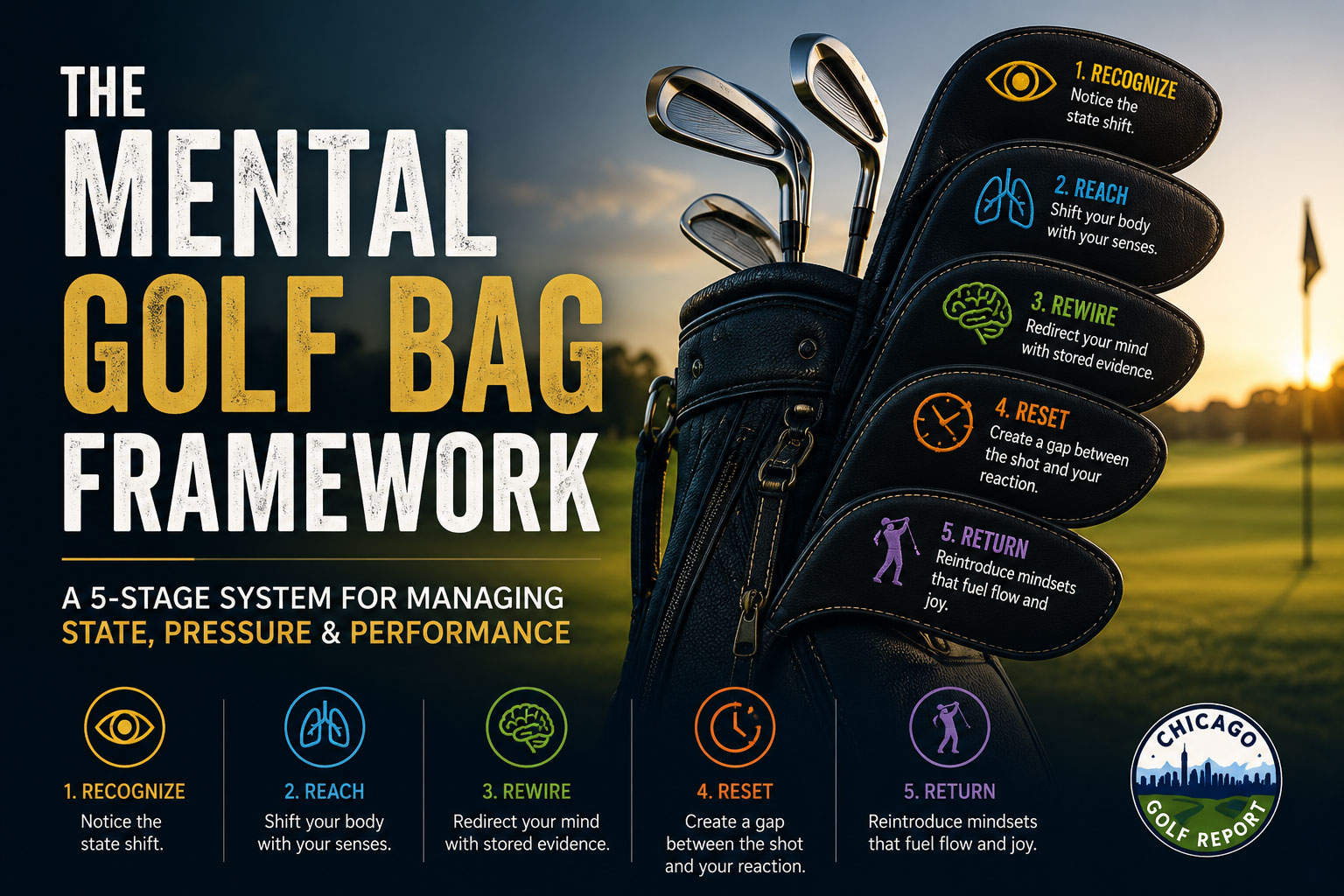
A Chicago Golf Report synthesis — organized and named from ideas described by Hallam Morgan of FlowCode.
Morgan did not name or structure this framework himself; the underlying tools — the golf-bag analogy, the four ways to shift state, the post-shot routine, the great shot book, and the flow mindsets — are his. The five-stage sequence below is Chicago Golf Report’s organization of those tools into a repeatable system.
The core idea
Golfers don’t lose their swing under pressure — they lose their state: the mental, emotional, and physical condition (heart rate, grip pressure, tempo) that determines whether their swing is even accessible in the moment.
Most players face pressure with an empty mental golf bag, or with exactly one club in it (“take a deep breath”). The Mental Golf Bag framework is a sequence for stocking that bag and knowing which club to reach for, when.
The five stages
1. Recognize
Notice that your state has shifted, before you swing.
The trigger to watch for: a change in heart rate, a tightening grip, or a tempo that’s sped up from what it was on the range. This is the moment most golfers skip entirely — they feel the shift and swing anyway, on autopilot. Recognizing it is what creates the opening to do something about it.
Why it works: you cannot manage a state you haven’t noticed you’re in. This stage is pure awareness — no technique yet, just the pause to register “something changed.”
2. Reach (Sensory Flow)
Use a fast, physical tool to shift your body’s state directly.
Two go-to tools: the slow breath — full inhale through the nose into the belly, then the slowest possible exhale through pursed lips — and soft focus with expanded awareness — fix your eyes softly on a distant point, then expand your awareness 180 degrees around it without moving your eyes.
Both work through the nervous system directly — no cognitive effort required, which is exactly why they work when your thinking brain is already flooded.
Why it works: the senses are one of only two things always fully within your control; the other is mindset. Environment and the people around you shift your state too, but you can’t always control either — so the framework starts with what’s always available.
3. Rewire (Cognitive Flow)
Redirect the internal narrative using stored evidence, not willpower.
This stage draws on two tools: self-talk awareness, and recall — specifically, a “great shot book” kept by club, logging past great shots in vivid multi-sensory detail.
The test for whether this stage needs work: can you instantly recall a great shot with every club in your bag?
Any gap is a club where, under pressure, your mind will default to the negative memory instead, simply because that’s what’s actually stored there.
Why it works: the brain reaches for whatever memory is most available. If the great-shot memory isn’t built and stored ahead of time, the only thing available under pressure is the negative one — because negative experiences are naturally stickier.
4. Reset (Post-Shot Routine)
Create a deliberate gap between the shot and your reaction to it.
The simplest version: watch every shot to completion, good or bad, until the ball is no longer visible, before saying or thinking anything about it.
That pause creates space between the stimulus — the shot — and the response — the self-talk — giving the slower, rational brain time to catch up to the fast, reactive emotional one.
Why it works: without a gap, the reaction is automatically emotional and critical, because the emotional brain processes faster. The gap doesn’t eliminate the reaction — it changes it from critical (“why did you do that”) to curious (“I wonder why that happened”).
5. Return (Flow Mindsets)
Deliberately reintroduce the mindsets that made the game fun before self-consciousness and pressure crowded them out.
Rotate mindsets hole to hole:
- Awe mindset: being genuinely amazed by what the swing just did.
- Playful mindset: choosing a shot for the fun of it, not just the optimal line.
- Gratitude mindset: noticing the privilege of being out there at all.
Why it works: mastery and social pressure quietly displace the childlike engagement that made the sport enjoyable — and enjoyable states are, not coincidentally, also the states in which people perform and learn best.
This stage closes the loop by returning the golfer to the state the whole framework is trying to protect.
Why the sequence matters
Each stage solves a different failure point.
- Skipping Recognize means golfers swing from an already-compromised state without knowing it.
- Skipping Reach means they try to think their way out of a physiological problem.
- Skipping Rewire means the negativity bias runs unchecked.
- Skipping Reset means every mistake compounds into the next shot.
- Skipping Return means even good technical execution stays joyless — which, over a round or a season, erodes the motivation to keep training the other four stages at all.
Practical applications
On the course
Run the full sequence after any shot that produces a visible state spike — not just bad shots, since even great shots can spike adrenaline in ways that affect the next one.
In practice
Apply Recognize and Reach before a session, since learning itself is state-dependent — a frustrated or anxious range session teaches less per rep than a calm one.
Off the course
The same five stages transfer to any high-stakes performance moment — a presentation, a difficult conversation, a competitive negotiation.
Recognize the tell — racing thoughts, tight shoulders. Reach for breath or a fixed visual point. Rewire using a mental log of past wins. Reset with a pause before responding to criticism. Return by finding the part of the work that’s still enjoyable.
This framework is Chicago Golf Report’s synthesis of ideas described by Hallam Morgan of FlowCode. It is intended as a reusable reference point for future interviews that touch on state management, pressure performance, or mental training — future guests’ ideas can be compared against, or plugged into, this five-stage structure.









 Find a Golf Course
 Find a Driving Range
 Find a Topgolf
 Find a Golf Instructor