
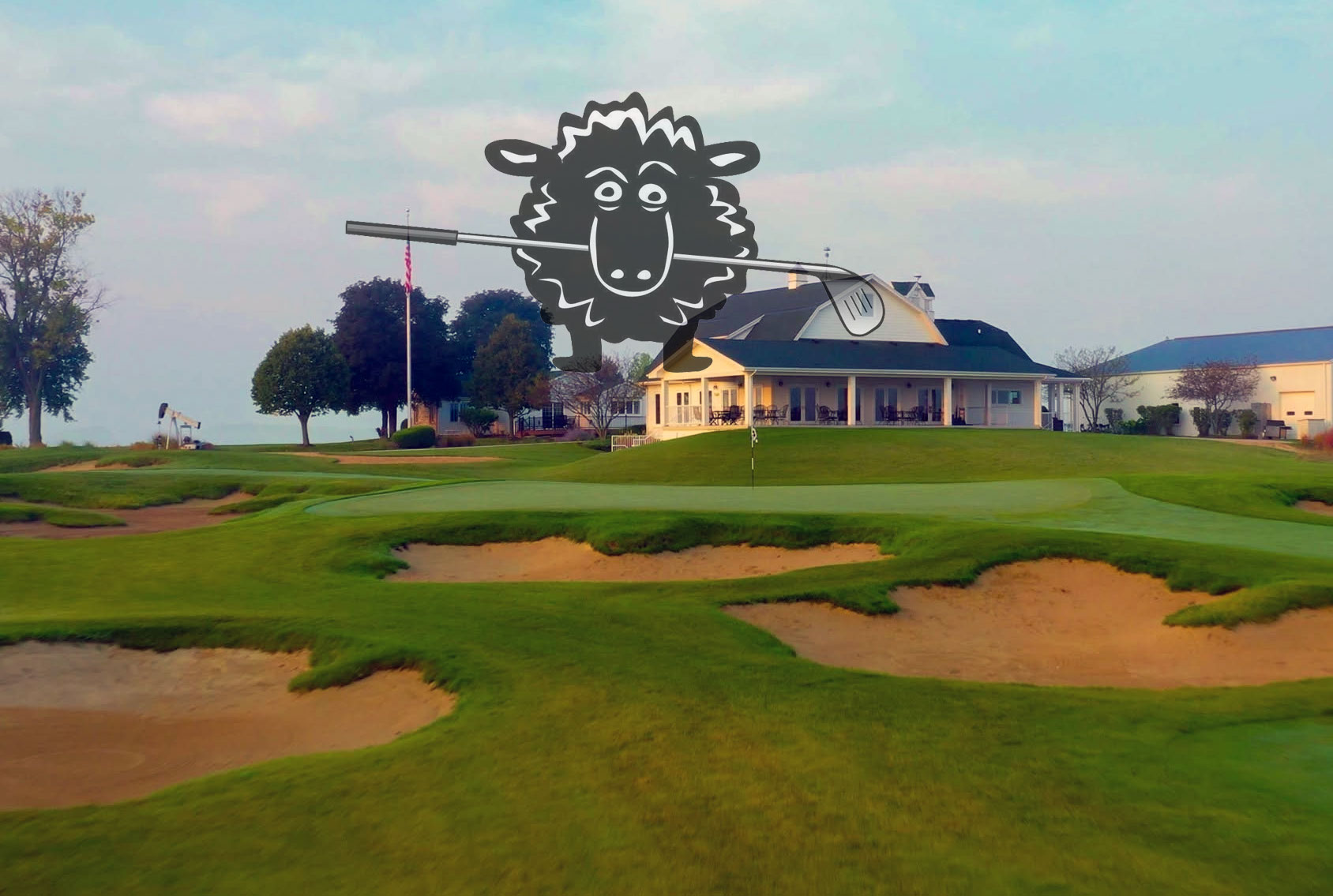
Black Sheep Golf Club does not have the century-old history of many of Chicago’s most celebrated private clubs. It has never hosted a U.S. Open, Western Amateur or PGA Tour event. Its clubhouse was not designed to accommodate lavish weddings, formal dinners or an extensive social calendar.
That is precisely what makes the Sugar Grove club historically significant.
When Black Sheep opened in 2002, it represented a conscious rejection of the direction in which many golf developments had been moving. There would be no surrounding subdivision, swimming pool, tennis courts or sprawling clubhouse. Instead, its founders created a club devoted almost exclusively to golf: 27 championship holes, an expansive practice facility and an informal gathering place for golfers.
More than two decades later, the original concept remains largely intact.
A Different Kind of Golf Club
The idea for Black Sheep emerged in the fall of 1999, when a small group of golfers began discussing the creation of an exceptional course in a casual, unpretentious environment.
Vincent Solano Sr., a founding member and president of Robin Hill Development Company, helped oversee the project. Rather than using golf to anchor a residential development, the founders envisioned a private club modeled more closely on the traditional golf clubs of Scotland, England and Ireland.
The course would occupy approximately 285 acres of former farmland about 40 miles west of downtown Chicago. Construction began in the fall of 2000, and the course was substantially completed by October 2001 before opening for play in the spring of 2002.
The original clubhouse reflected the same restraint. A 2001 construction report described plans for a 6,200-square-foot, barn-style building with a locker room, small golf shop and large bar—but no traditional restaurant kitchen. Golf, rather than dining or social programming, would remain the central attraction.
The club’s philosophy continues to be defined partly by what it does not offer: no houses or condominiums lining the fairways, no hotel, no pool and no tennis facilities. According to the Black Sheep Golf Club website, the objective remains to provide “golf in its purest state” in an informal atmosphere centered on the game and the camaraderie among members.
David Esler’s First Solo Design
Black Sheep was designed by St. Charles-based architect David Esler. It was Esler’s first solo golf-course design and remains one of the clearest expressions of his architectural philosophy.
Esler earned a degree in landscape architecture from Ohio State University, where he also competed on four Big Ten championship golf teams. He later played professional golf before establishing Esler Golf Designs in 1989.
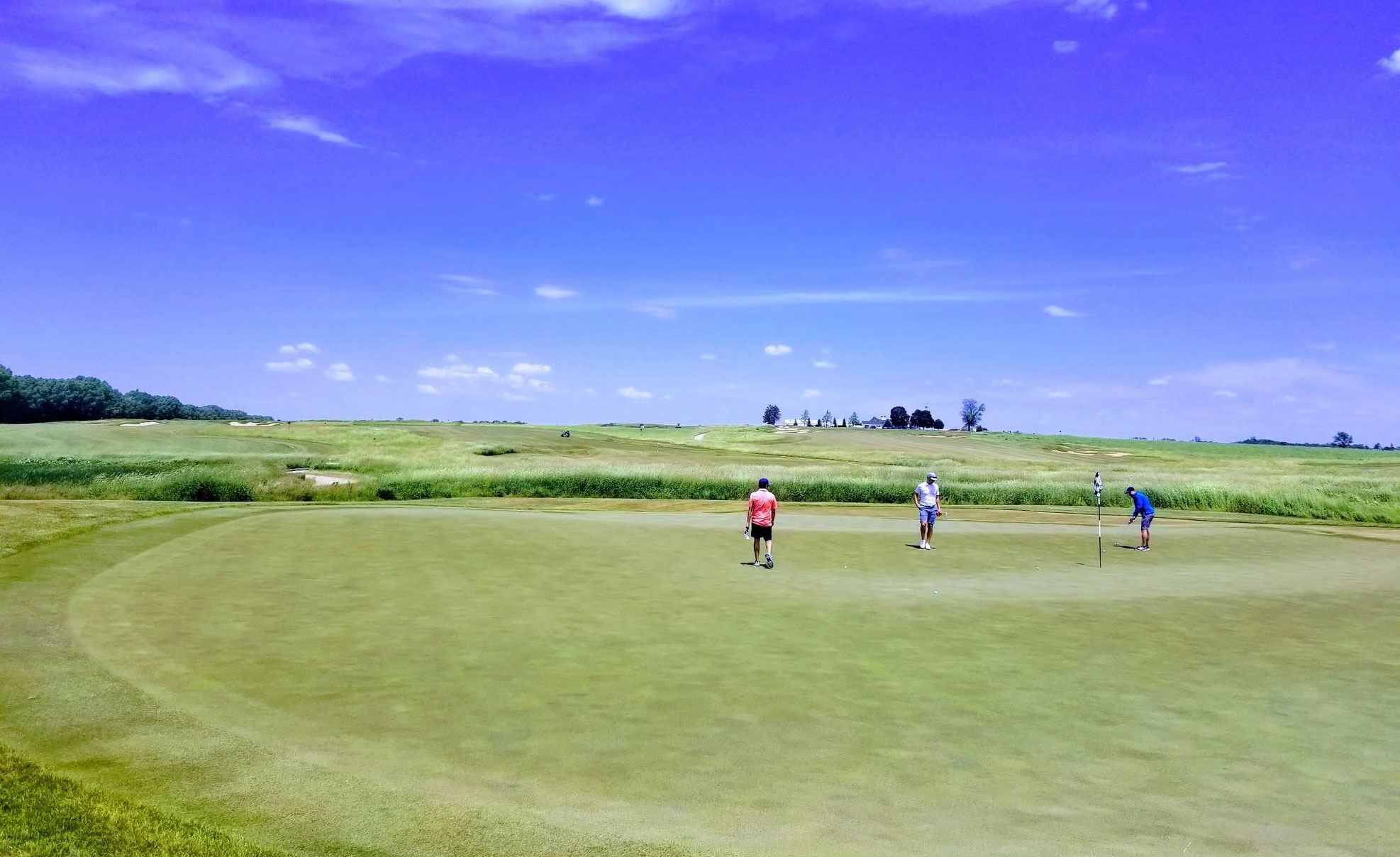
For Black Sheep, Esler designed all 27 holes, the driving range, short-game area and an enormous two-acre putting green. Wadsworth Golf Construction of Plainfield handled the original course construction.
Esler inherited a broad, gently rolling agricultural property with few trees and long views across the prairie. Instead of imposing an artificial landscape on the site, he used its existing contours and elevation changes. Relatively little earth needed to be moved during construction.
“The grand scale of the land we had to work with enabled us to incorporate a great deal of strategy into the design,” Esler explained in a contemporary Golf Course News construction report.
The original plan also called for approximately 140 acres of native prairie grasses and 15 acres of wetlands. These areas helped return the former farm to something resembling the native Illinois landscape while providing wildlife habitat, stormwater management and natural hazards for the golf course.
Classic Strategy on an Illinois Prairie
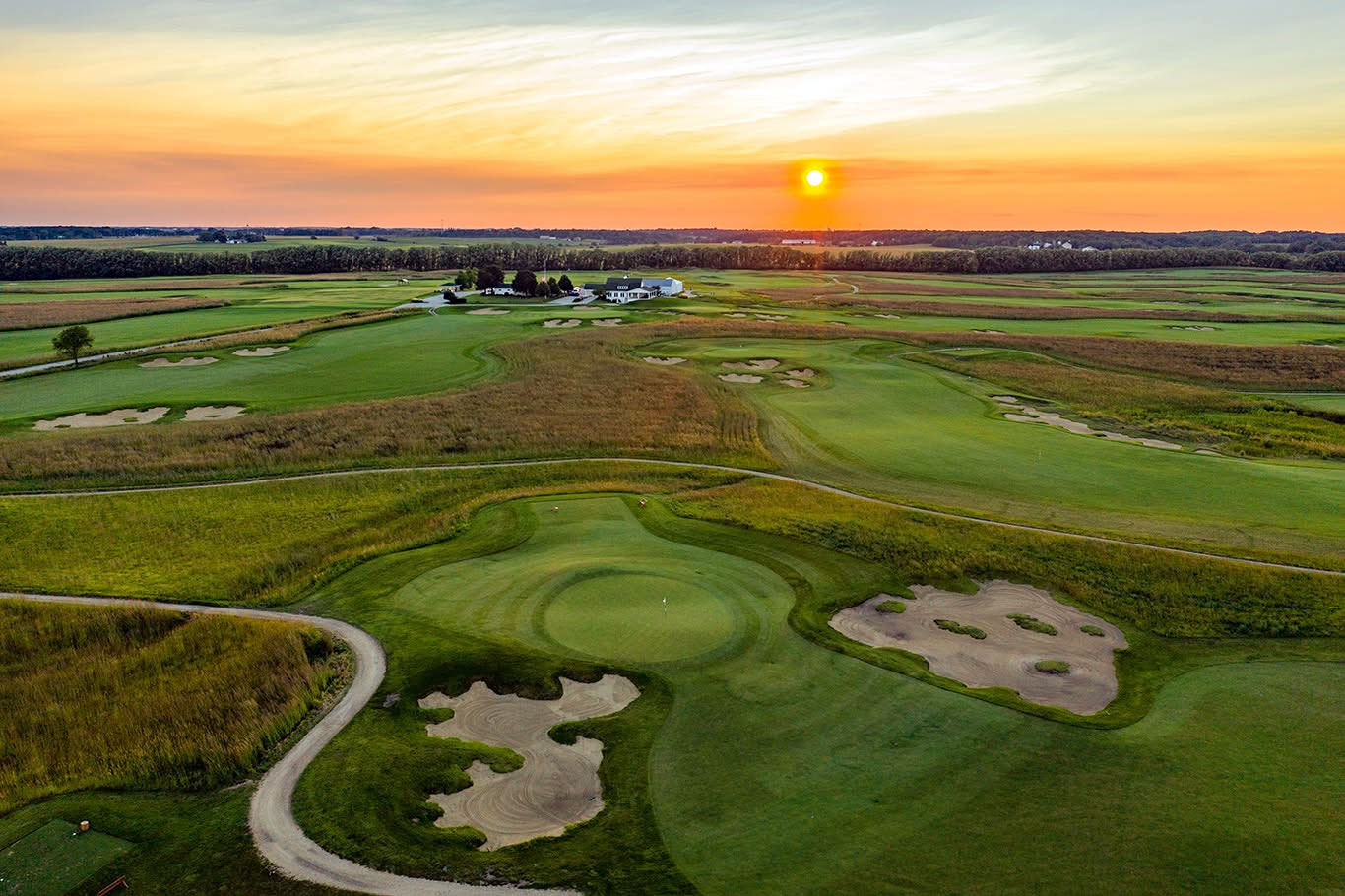
Black Sheep was conceived in the spirit of inland courses such as Shinnecock Hills, Prairie Dunes and Sand Hills. Those influences are reflected not through copied holes, but through strategic width, exposed terrain, native vegetation and the importance of wind.
The club consists of three par-36 nines, numbered 1 through 27. Golfers can combine any two nines to create three different par-72 courses. From the black tees, the combinations currently measure 7,111, 6,930 and 7,107 yards, according to the Chicago District Golf Association.
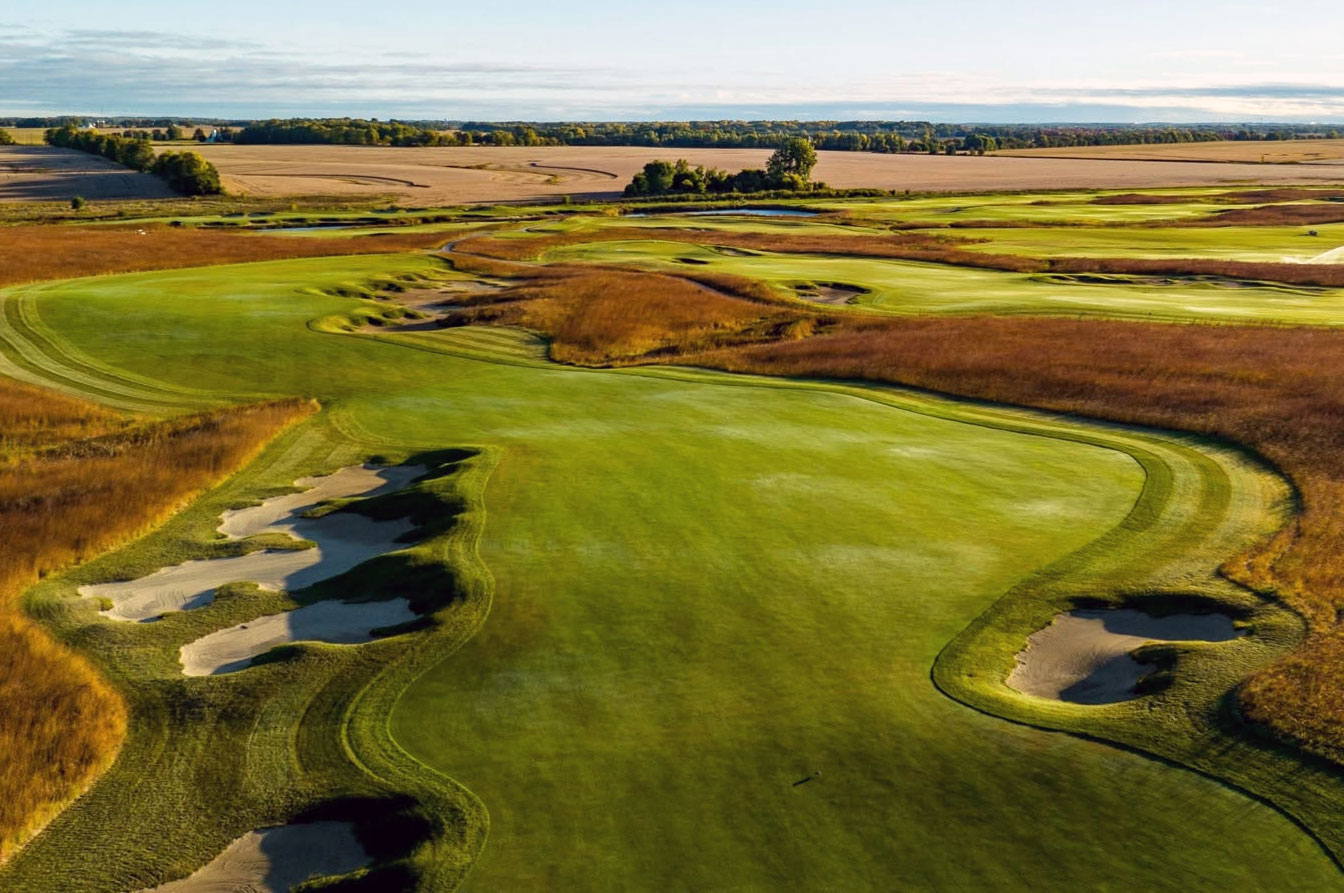
Black Sheep’s unusually broad fairways are central to its strategy. Merely finding the short grass does not guarantee that a golfer has selected the correct line. Players who challenge prairie, water, wetlands or bunkers may earn a clearer view, shorter approach or better angle into the green. A safer tee shot can leave a more complicated second shot.
That width makes the course playable for golfers of differing abilities without eliminating the challenge for accomplished players.
The greens vary considerably in size, shape and contour. Bunkers frequently influence the preferred angle of approach, while subtle and pronounced slopes create a wide range of possible hole locations. The club estimates that the course contains more than 300 waste, fairway, approach and greenside bunkers.
Then there is the wind.
With few trees or buildings to shelter the holes, Chicago’s constantly changing winds are among Black Sheep’s most important defenses. Esler routed each nine with prevailing winds in mind, but the openness of the property means golfers rarely experience exactly the same course twice.
Recognition Arrived Quickly
Although Black Sheep was new, its architecture quickly attracted national attention.
In 2008, Golfweek ranked the club No. 56 among America’s 100 Best Modern Courses. It was the fourth consecutive year in which Black Sheep had appeared on the list, meaning its national recognition began only a few years after opening.
Only Butler National joined Black Sheep among Chicago-area courses included in Golfweek’s modern-course ranking that year. The publication credited Esler’s strategic design, the property’s rolling prairie terrain and the club’s uncompromising golf-only identity.
“Strategy is the foundation of any great golf course,” Esler said in the 2008 Golfweek ranking announcement, explaining that the principle governed the project from its beginning.
Black Sheep also developed a connection to professional golf through Kevin Streelman. The Wheaton native practiced and played at the club and was named its staff touring professional in 2008, the same year he established himself on the PGA Tour.
Evolution Without Reinvention
Unlike many prominent courses from its era, Black Sheep has not undergone a documented wholesale redesign. There is no public record of a major rerouting, comprehensive green reconstruction or extensive lengthening campaign.
Instead, the course has evolved primarily through the maturation of its prairie landscape, turf and playing conditions. Its three original nines, strategic fairway corridors and fundamental architectural ideas remain recognizable.
The club’s most clearly documented improvement occurred during the fall and winter of 2019–20, when it renovated the practice facility. The project improved the short-game area and incorporated a putting course into the existing two-acre putting-green complex.
That work enhanced one of the club’s original strengths without altering the championship course. Published yardages from 2020 match the current CDGA totals for all three 18-hole combinations, providing strong evidence that the project was confined to the practice grounds.
A Limited Tournament History by Design
Black Sheep has not built its identity around hosting major outside championships. No national professional event, USGA championship, NCAA championship or flagship CDGA competition has been publicly documented at the club.
That absence appears consistent with its operating philosophy. Black Sheep was created to give members access to serious golf rather than depend heavily on outings and outside-event revenue.
The course has nevertheless hosted selected competitions. The 2019 Illinois–Wisconsin Writer’s Cup was played at Black Sheep, with Team Wisconsin retaining the Reid Hanley Trophy.
In October 2020, the club hosted the final round of Northern Illinois University’s Titleist/FootJoy Invitational. The event was part of an intrasquad series created after the COVID-19 pandemic disrupted NIU’s regular collegiate schedule. Jordan Less closed with a three-under-par 69 at Black Sheep to win the tournament by eight strokes.
Those events demonstrate that the course is capable of providing an exacting competitive test. Its modest tournament résumé, however, reflects the club’s priorities rather than a limitation of the architecture.
Black Sheep’s Place in Chicago Golf
Black Sheep occupies an unusual position in Chicago golf history. It is a modern course inspired by traditional architectural principles, a private club created without real-estate development and a nationally recognized design that has remained largely faithful to its original form.
Its history is not a story of repeated renovations or famous championships. It is the story of a remarkably focused idea.
The founders wanted a place where golfers could arrive, play a serious course, share a meal or drink, discuss the round and return another day. David Esler translated that idea into 27 strategic holes across an exposed Illinois prairie.
Since opening in 2002, the landscape has matured and the practice grounds have improved, but Black Sheep has resisted the temptation to become something broader or more elaborate.
In an industry often shaped by expansion, amenities and reinvention, Black Sheep Golf Club remains notable for knowing exactly what it wanted to be—and continuing to be it.







 Find a Golf Course
 Find a Driving Range
 Find a Topgolf
 Find a Golf Instructor