
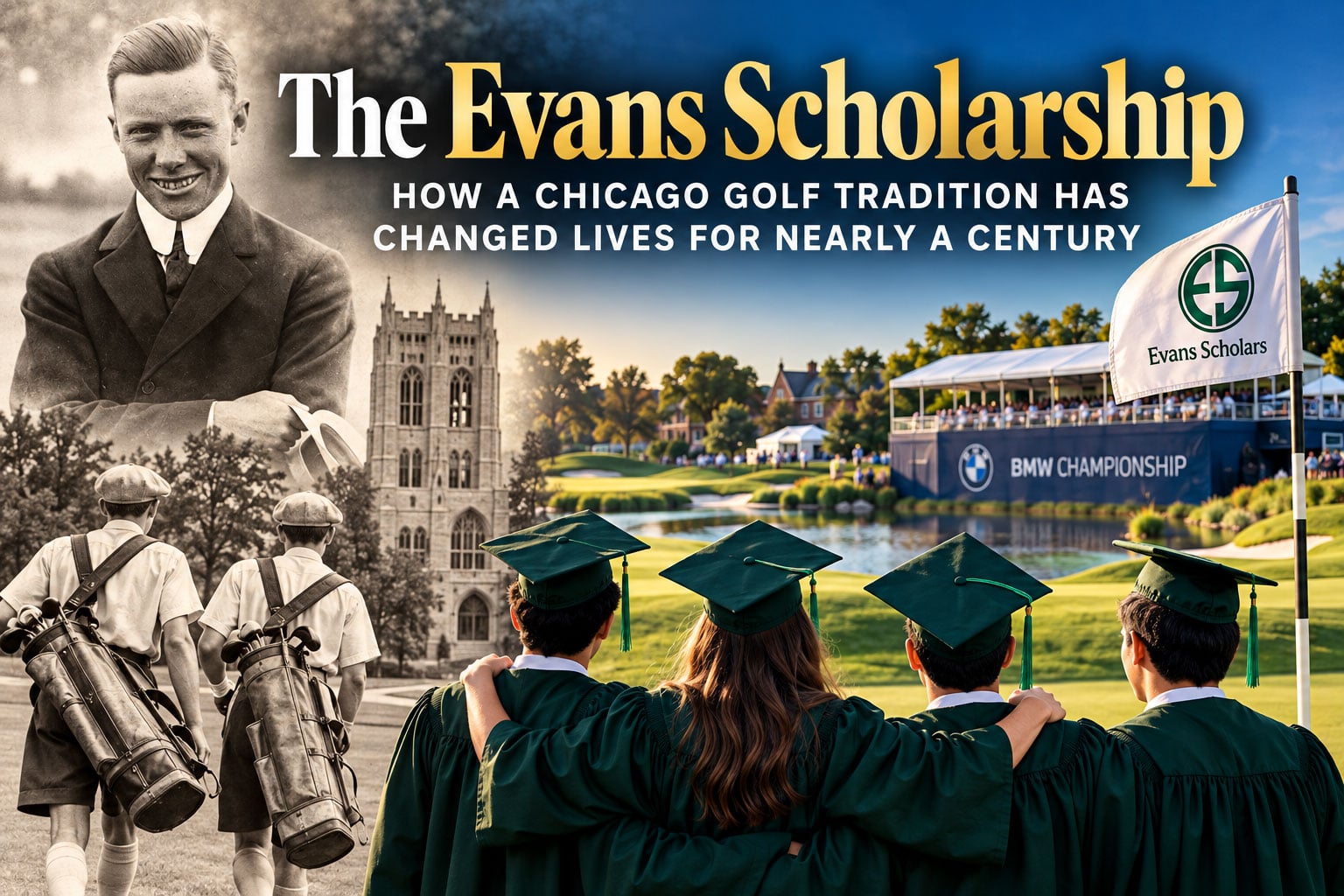
From two caddies attending Northwestern University in 1930 to more than 12,500 college graduates, the Evans Scholars Foundation has created an extraordinary legacy of educational opportunity. Its influence may extend well beyond the individuals who received scholarships.
In 1930, two young caddies named Harold Fink and Jim McGinnis enrolled at Northwestern University with an opportunity that would change their lives. Their tuition and housing were covered through a new scholarship program inspired by one of Chicago’s most accomplished amateur golfers, Charles “Chick” Evans Jr.
Neither the students nor the program’s founders could have known how far that original investment would reach.
Nearly a century later, the Evans Scholars Foundation has helped more than 12,575 young men and women graduate from college. For the 2025–26 academic year, a record 1,260 Evans Scholars were enrolled at 27 universities nationwide.
Those figures alone establish the Evans Scholarship as one of golf’s most consequential philanthropic achievements.
But they raise a more intriguing question: What happens when an educational opportunity changes not only one person’s future, but potentially the futures of an entire family?
The answer may be the most important part of the Evans Scholarship’s legacy.
A Dream Born From Financial Hardship
Chick Evans understood both the opportunities and limitations of education.
Born in 1890, Evans moved to Chicago with his family as a child and began caddying at Edgewater Golf Club. He eventually became one of the country’s greatest amateur golfers, winning both the U.S. Open and U.S. Amateur championships in 1916.
Rather than pursue a professional golf career, Evans maintained his amateur status. With the encouragement of his mother, Lena, he envisioned using proceeds associated with his golf activities to help young caddies afford college.
Evans knew firsthand that financial circumstances could interfere with educational ambitions.
In a 2023 Chicago Golf Report podcast interview, Western Golf Association Senior Vice President of Tournaments Vince Pellegrino discussed how Evans’ inability to complete his own education helped inspire the scholarship program.
The Western Golf Association agreed to administer the scholarship fund, and in 1930 the first two recipients entered Northwestern University.
What began with two students eventually developed into a national program supported by donors, golf clubs, alumni, and championship revenues.
The underlying premise has remained remarkably consistent: Young people who demonstrate a strong caddie record, academic achievement, outstanding character, and financial need deserve an opportunity to pursue higher education.
The Evans Scholarship by the Numbers
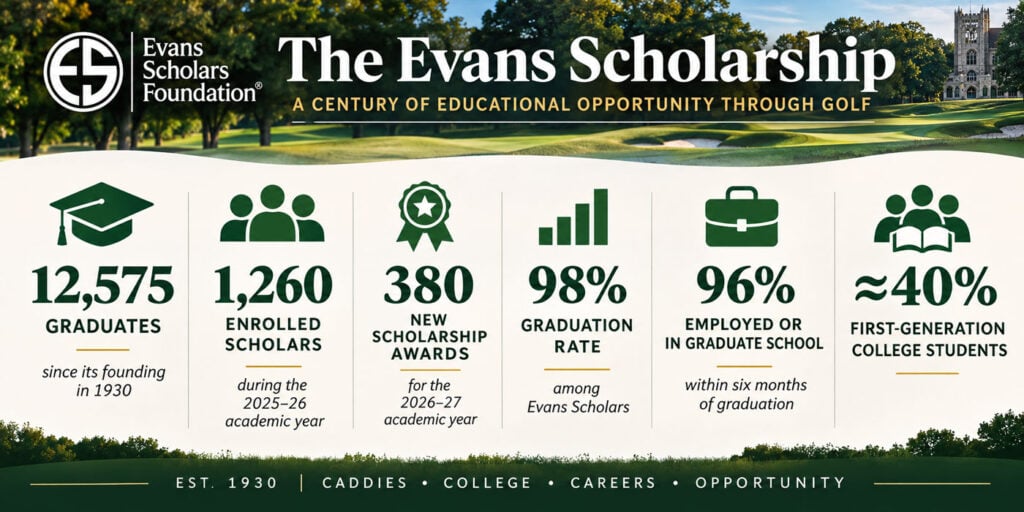
The foundation’s reported accomplishments are substantial.
According to the Western Golf Association, the program has achieved:
- 12,575 graduates since its founding in 1930.
- 1,260 enrolled scholars during the 2025–26 academic year.
- 380 new scholarship awards for the 2026–27 academic year.
- 98% graduation rate among Evans Scholars.
- 96% of graduates employed or enrolled in graduate school within six months of graduation.
- Approximately 40% first-generation college students.
The foundation also reports a cumulative grade-point average of 3.3 among its scholars.
These are impressive educational outcomes, particularly for a scholarship program that explicitly considers financial need.
The Evans Scholarship covers full tuition and housing, removing two of the largest expenses associated with attending college.
Yet the program’s structure extends beyond financial assistance.
Evans Scholars often live together in scholarship houses, where students participate in chapter leadership, service activities, and campus life. The foundation also provides academic, professional, and social resources intended to support students throughout their college experience.
These features suggest that the Evans Scholarship is designed not simply to help students enroll in college, but to help them complete their degrees and prepare for life afterward.
The WGA reports a 98% graduation rate, although the publicly available materials reviewed for this article do not specify the exact graduation time frame or calculation methodology. Similarly, the reported 96% employment or graduate-school figure does not, by itself, establish how many graduates obtained positions through the program’s professional network.
Those distinctions matter when evaluating the results. Nevertheless, the combination of financial assistance, residential community, and continued support is a significant part of the foundation’s educational model.
From Riverside Golf Club to the Western Golf Association
For Vince Pellegrino, the Evans Scholarship was more than an educational benefit. It helped establish the direction of his professional life.
Pellegrino grew up in Cicero, Illinois, and attended Fenwick High School. His father worked three jobs, while his mother also worked part-time. His family had limited financial resources.
He began caddying at Riverside Golf Club after the family’s dentist, a club member, suggested it would be a good summer job.
In an earlier Chicago Golf Report interview, Pellegrino recalled that his parents recognized the potential value of the Evans Scholarship before he fully appreciated the opportunity himself.
He enjoyed earning money, learning about golf, and meeting people at the club.
Eventually, his years of caddying, academic performance, and financial circumstances qualified him to apply for the scholarship.
He received an Evans Scholarship to attend Indiana University.
During his junior year, Pellegrino obtained an internship with the Western Golf Association, helping organize its golf championships. He returned for another internship after his senior year.
His first job after college came through another Evans Scholar alumnus, Kevin Donnellon, who owned a Chicago public relations firm.
Donnellon hired Pellegrino and another Evans Scholar, providing an early professional opportunity through the alumni community.
Four months later, John Kaczkowski contacted Pellegrino about an opening at the Western Golf Association.
Pellegrino joined the organization in February 2000 and eventually became its senior vice president of tournaments, overseeing some of the most prestigious championships in golf.
His career offers a tangible example of how the Evans Scholarship can influence a recipient long after college graduation.
The financial assistance helped him attend Indiana University. His college experience introduced him to professional opportunities. An Evans Scholar alumnus helped him secure his first job. Another connection eventually brought him back to the organization responsible for his scholarship.
In a recent interview on Kash and Matty Talking Golf, Pellegrino reflected on the significance of that opportunity:
“It changed my life, changed my trajectory of my career.”
His experience illustrates something that cannot be fully captured by a graduation statistic: the potential long-term value of education, relationships, and professional access.
An Investment That Extends Beyond the Student
The Evans Scholarship is awarded to individuals, but its financial consequences can extend to their families.
College tuition and housing represent substantial financial commitments. When those expenses are covered by a scholarship, families may be able to avoid debt, preserve savings, or direct resources toward other needs.
Pellegrino emphasized this broader benefit during his recent interview.
He described the scholarship as life-changing not only for recipients but for their entire families, explaining that it removes a major burden associated with paying for college.
That observation introduces a question worth considering as the foundation approaches its centennial.
How many people have ultimately benefited from the educational opportunities provided to more than 12,500 Evans Scholars?
Some of the program’s earliest graduates may have children, grandchildren, great-grandchildren, and even great-great-grandchildren today.
A college education can influence career opportunities, earnings, financial stability, and the educational expectations of future generations.
Those effects are not automatic, and they cannot be reliably calculated by simply multiplying the number of graduates by the size of their families.
The foundation’s published statistics also do not establish how many descendants have benefited economically or educationally from a relative’s scholarship.
Still, the possibility is significant.
A scholarship awarded in 1940 might have influenced decisions made by a family over several subsequent generations. A scholarship awarded today may have consequences that will not become fully apparent until decades from now.
The cumulative impact could be considerably broader than the foundation’s graduate count, even if its full extent has not been measured.
That is an important distinction between the number of people who directly receive a scholarship and the larger legacy that educational opportunity may create.
How Golf Championships Help Fund College Educations

BMW Championship at Conway Farms Golf Club
The Evans Scholars Foundation also occupies a distinctive position within professional golf.
The Western Golf Association, established in 1899, operates major golf championships while administering the scholarship program.
Its most prominent fundraising vehicle is the BMW Championship, a PGA TOUR FedExCup Playoffs event.
In a 2023 Chicago Golf Report interview, Pellegrino reported that the 2021 BMW Championship at Caves Valley Golf Club generated $5.6 million for the Evans Scholars Foundation. The following year’s championship at Wilmington Country Club generated approximately $4.6 million.
Those tournament proceeds help support scholarships, but the championship’s impact extends beyond fundraising.
As the BMW Championship moves among major golf markets, the WGA can introduce the Evans Scholarship to new clubs, donors, prospective caddies, and communities.
During his recent interview, Pellegrino connected the tournament’s geographic rotation to scholarship expansion, citing new scholarship houses at the University of Maryland and the University of Delaware.
He also discussed plans for a Rutgers University scholarship house in conjunction with the BMW Championship’s scheduled return to the New York metropolitan area in 2027.
This strategy connects elite professional golf with educational opportunity in communities far beyond Chicago.
A tournament may last four days, but the relationships and financial commitments developed around it can support students for years.
Evans Scholars Invitational Finds a New Home in 2027
The Western Golf Association’s commitment to educational opportunity also extends to the Korn Ferry Tour through the Evans Scholars Invitational. Established in 2019, the tournament provides a competitive stage for emerging professional golfers while raising awareness and support for the Evans Scholars Foundation.
Its inaugural champion, Scottie Scheffler, went on to become one of the world’s most accomplished golfers. After spending most of its history at The Glen Club in Glenview, the tournament will move to Stonebridge Country Club in Aurora in 2027, bringing the event to the Fox Valley for the first time.

Designed by Tom Fazio and opened in 1989, Stonebridge has previously hosted PGA Tour Champions and LPGA Tour events, including tournaments won by Annika Sorenstam and Karrie Webb. The 2027 Evans Scholars Invitational is scheduled for July 19–25, with tournament competition taking place July 22–25.
While the event will showcase aspiring PGA Tour professionals, its broader purpose reflects the WGA’s nearly century-long mission. Like the BMW Championship, the Evans Scholars Invitational connects the competitive side of golf with a charitable commitment to helping deserving young caddies pursue college educations. The move to Stonebridge provides another opportunity to introduce the scholarship’s mission to golf fans, sponsors, and communities throughout Chicagoland.
A Growing National Network
The Evans Scholars Foundation continues to expand the opportunities available to young caddies.
The WGA reported a record 380 new scholarship awards for the 2026–27 academic year, including more than 135 recipients from the Chicago area.
The foundation is also developing caddie opportunities in communities where young people might otherwise have limited access to the game.
Its Caddie Academy program, for example, introduces students to caddying, employment experience, mentorship, and the possibility of qualifying for an Evans Scholarship.
That work addresses an important practical challenge: Students cannot earn a caddie scholarship if they never have an opportunity to become caddies.
By developing additional entry points into the game, the WGA can potentially reach young people who might never have considered golf as a pathway to college.
Meanwhile, the program’s alumni remain an important part of its financial foundation.
According to the WGA, Evans Scholars alumni contribute more than $15 million annually, while the broader Evans Scholars Par Club includes more than 43,500 supporters.
That creates another form of continuity: Individuals who once benefited from the scholarship are helping finance opportunities for future recipients.
The Legacy of an Opportunity
When Chick Evans and the Western Golf Association sent two caddies to Northwestern University in 1930, they established something that would grow far beyond its original scale.
Today, the Evans Scholarship represents thousands of college graduates, a nationwide network of supporters, and a model connecting the game of golf with educational opportunity.
Its reported graduation and employment outcomes are noteworthy. Its financial commitment is substantial. And its continued expansion demonstrates that the original mission remains relevant.
But perhaps the program’s most meaningful achievement cannot be expressed in a single statistic.
Consider Vince Pellegrino’s journey: a young caddie from Cicero, the son of hardworking parents, who received an opportunity to attend Indiana University and eventually built a career helping lead the organization that made his education possible.
His story is one documented example among thousands of different paths taken by Evans Scholars.
Each scholarship creates an opportunity for an individual. Some of those opportunities may also influence families, careers, communities, and future generations.
As the Evans Scholars Foundation approaches its 100th anniversary in 2030, that larger legacy deserves attention.
Chick Evans set out to help deserving caddies afford college. Nearly a century later, the full reach of that idea may still be unfolding.
Learn more about the Evans Scholarship, eligibility requirements, and opportunities to support the program at wgaesf.org.









 Find a Golf Course
 Find a Driving Range
 Find a Topgolf
 Find a Golf Instructor
