
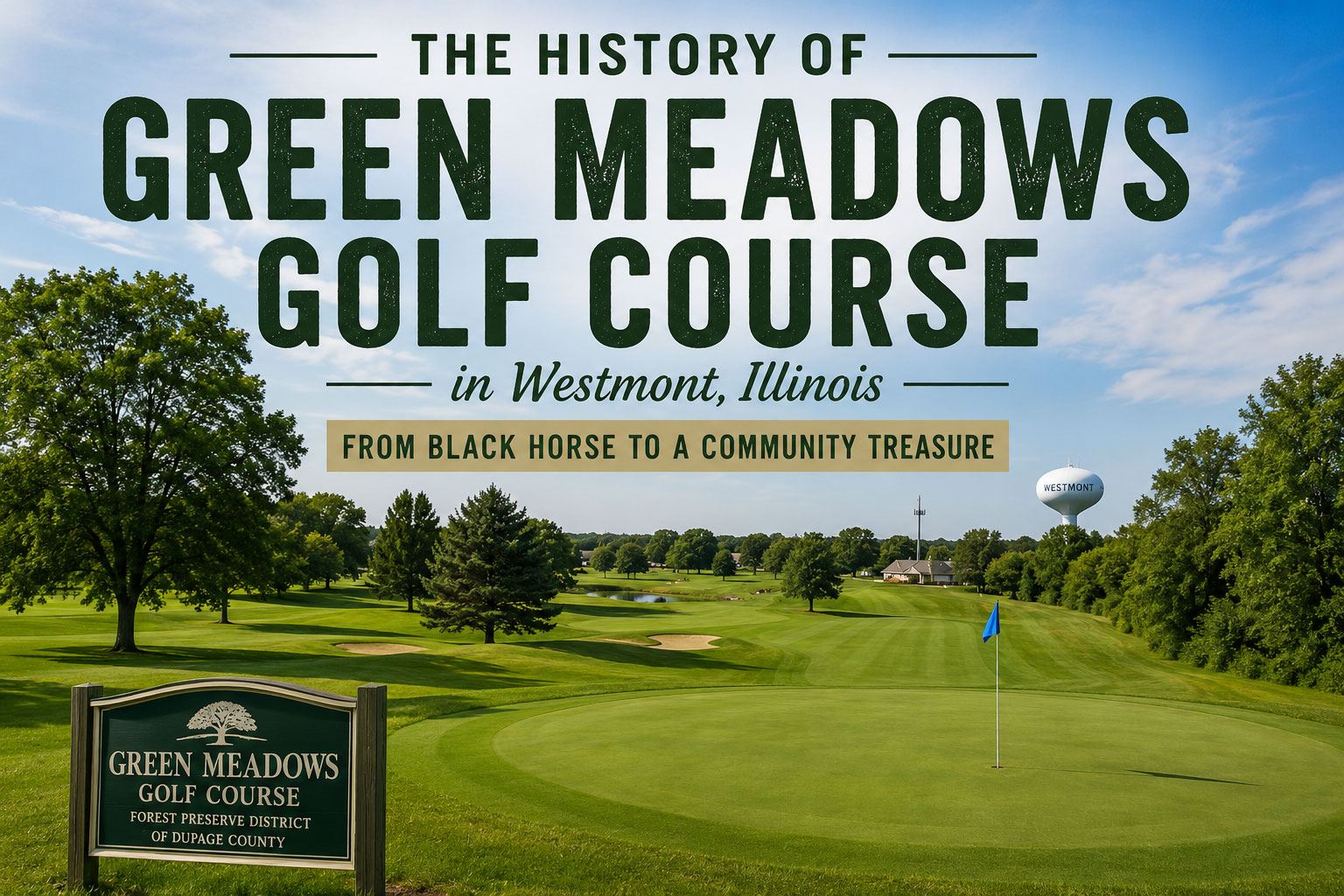
Green Meadows Golf Course in Westmont has quietly served generations of golfers looking for an affordable, approachable place to enjoy the game. While it may not possess the championship pedigree of some of Chicagoland’s larger facilities, Green Meadows has earned something equally valuable — a reputation as one of DuPage County’s most welcoming public golf courses and a remarkable example of a community coming together to preserve open space.
Today, Green Meadows is a charming nine-hole course operated by the Forest Preserve District of DuPage County, which also manages Maple Meadows Golf Course and The Preserve at Oak Meadows Golf Course. Its story, however, begins decades earlier under a different name and during a period when suburban development threatened to erase one of Westmont’s treasured green spaces forever.
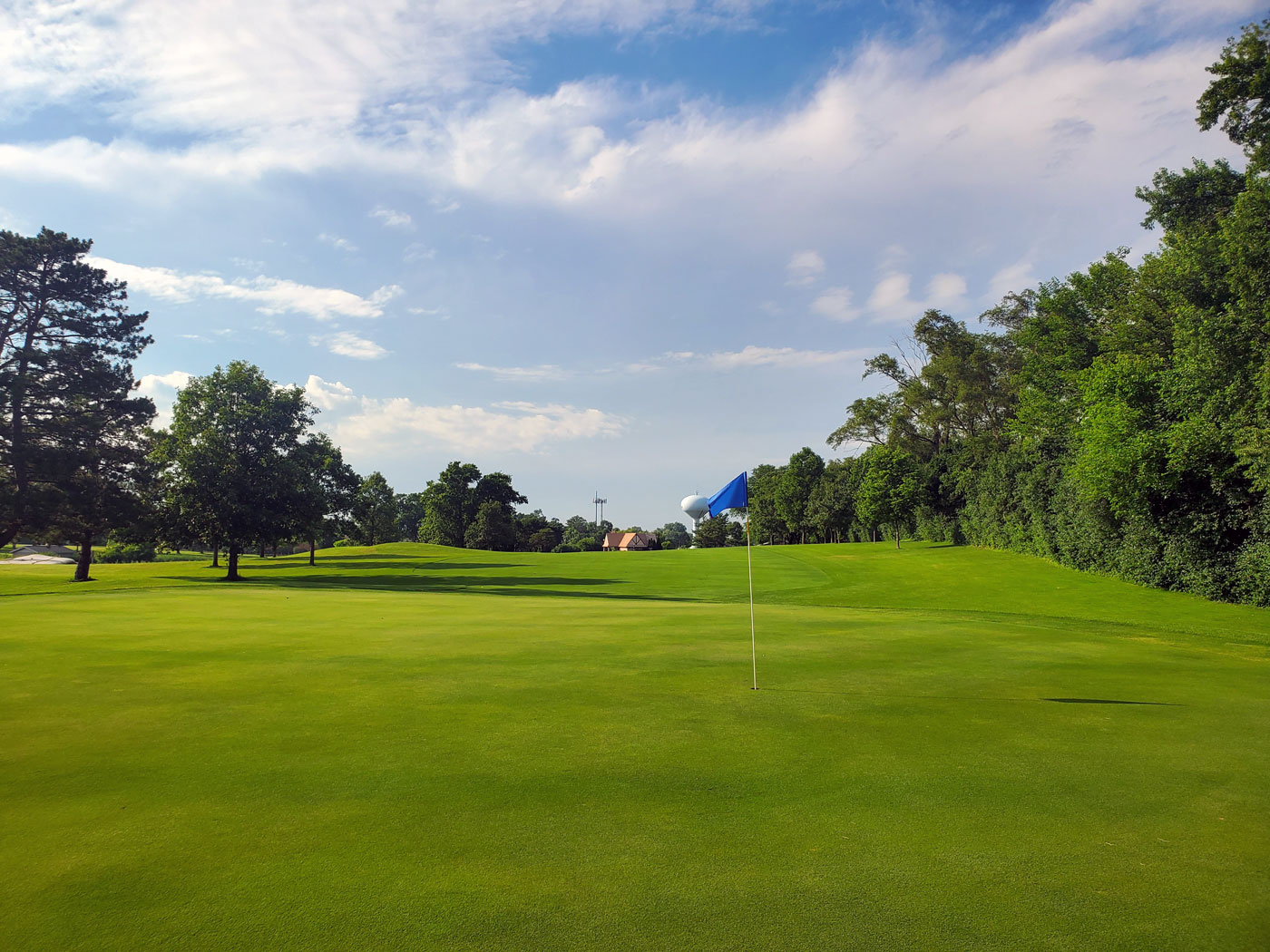
Green Meadows Golf Course – Hole 1
The Origins of Black Horse Golf Club
Green Meadows began life as Black Horse Golf Club, a family-owned nine-hole golf course established during the early 1960s.
Historical records differ slightly regarding its exact opening year. Various sources cite dates ranging from 1962 to 1965, but all agree that Jim and Jackie Kingsfield were instrumental in developing and operating the course. Jim Kingsfield is widely credited with designing the layout, creating a compact but enjoyable course that appealed to golfers of all skill levels.
Unlike many suburban courses built during the golf boom of the 1990s, Black Horse represented an earlier era of golf architecture. Rather than stretching beyond 6,500 yards, it emphasized shot-making, accuracy, and walkability. Measuring less than 2,000 yards, the course featured three par fours and six par threes — a format that remains unchanged today.
For nearly three decades, the Kingsfield family operated Black Horse as a neighborhood golf course where beginners could learn the game, experienced golfers could sharpen their short games, and local residents could enjoy a quick nine holes after work.
A Community Treasure Faces an Uncertain Future
By the late 1980s, suburban growth throughout DuPage County was accelerating rapidly.
As development pressure increased, Black Horse Golf Club became an attractive target for redevelopment. Like many privately owned golf properties, the land itself had become increasingly valuable.
Recognizing what could be lost, Westmont residents and local officials began exploring ways to preserve the property as permanent open space.
The effort was anything but simple.
Negotiations stretched over several years as various governmental agencies attempted to assemble the funding necessary to purchase the approximately 50-acre property. Initial purchase offers failed, while debate continued regarding the future of the site.
Community members understood that once the land was developed, it would never return to being open green space.
Fortunately, preservation advocates ultimately prevailed.
An Innovative Partnership Saves the Course
In 1989, an innovative partnership between multiple public agencies secured the future of the golf course.
The Village of Westmont committed approximately $1.4 million toward the purchase, while the Westmont Park District pledged another $600,000. Together, those contributions formed a $2 million local investment that helped make the acquisition possible.
The Forest Preserve District of DuPage County agreed to purchase the property and operate it as a public golf course.
Official Forest Preserve records indicate the acquisition occurred during Fiscal Year 1989 at a purchase price of approximately $4.65 million, although later district acquisition records reference a 1990 closing at roughly $4.75 million. The differing figures appear to reflect accounting and acquisition records rather than conflicting ownership.
Regardless of the accounting timeline, one fact remains clear: Westmont had preserved one of its last remaining large open spaces.
Instead of becoming another residential subdivision or commercial development, the property would remain dedicated to recreation and conservation.
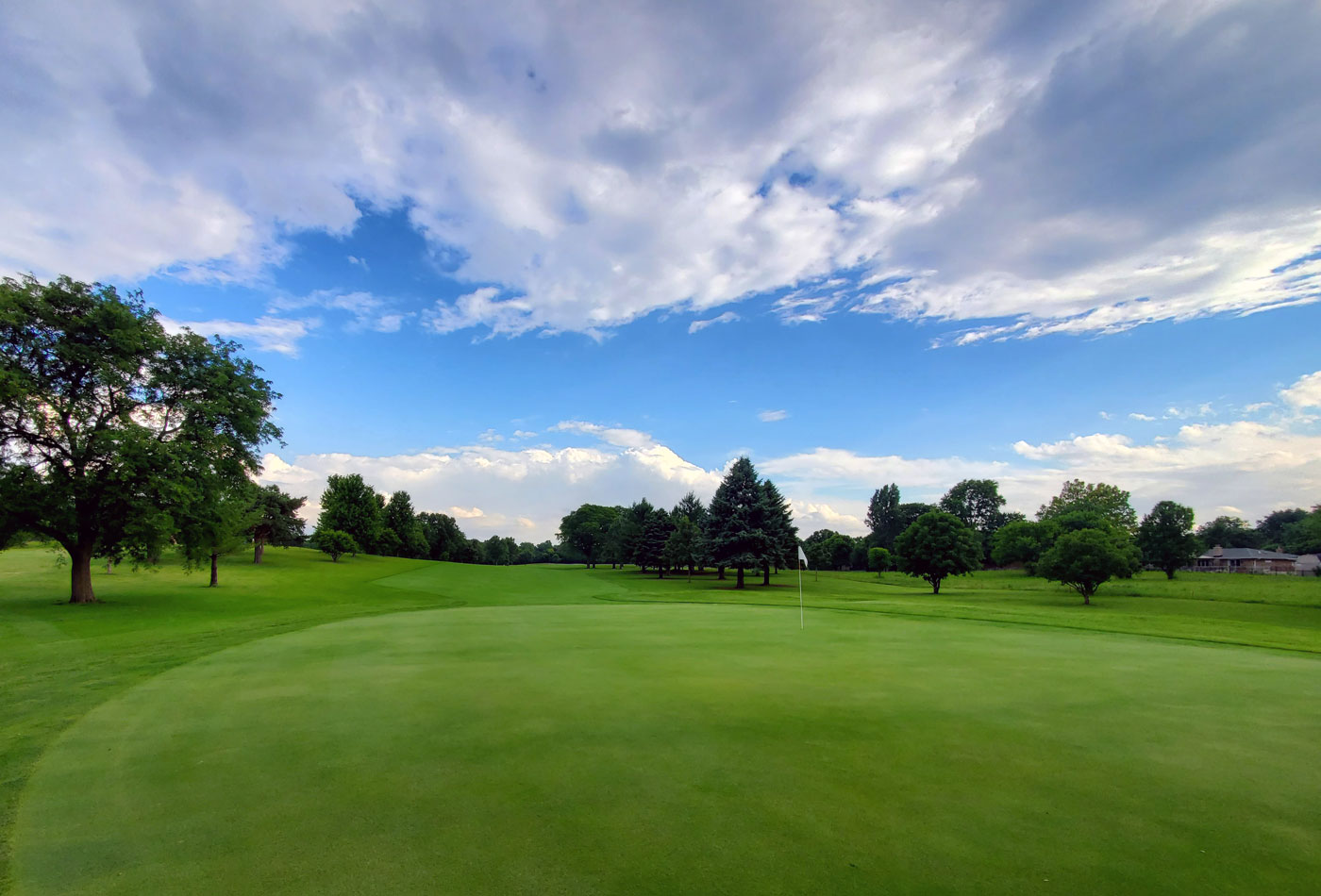
Green Meadows Golf Course – Hole 3
From Black Horse to Green Meadows
Although ownership changed in 1989, the transition to the new identity did not happen overnight.
Forest Preserve documents from early 1990 still referred to the property as Black Horse Golf Course, suggesting the original name remained in use during the initial months of public ownership.
Sometime during the 1990s, the course officially became Green Meadows Golf Course, reflecting its new role within the DuPage Forest Preserve golf system.
The new name better aligned the course with the district’s mission of combining outdoor recreation with environmental stewardship.
While the name changed, golfers found that much of the course itself remained remarkably familiar.
A Course That Has Changed Very Little
Unlike many public golf courses that undergo complete redesigns every few decades, Green Meadows has remained surprisingly consistent.
The Forest Preserve District’s long-range planning documents note that the most significant physical improvement occurred in 2004, when the parking lot was expanded to better accommodate visitors.
Otherwise, the course has remained largely unchanged.
That continuity has become one of Green Meadows’ defining characteristics.
Golfers returning after years away often discover the same compact routing, familiar greens, mature trees, and welcoming atmosphere they remember from earlier visits.
The course continues to offer an experience focused on fun rather than difficulty.
Playing just under 1,900 yards from the white tees, Green Meadows encourages beginners while providing experienced players an excellent opportunity to refine their wedges, short irons, and putting.
Looking Toward the Future
In 2013, the Forest Preserve District explored an ambitious concept for the property.
Working alongside golf organizations dedicated to growing the game, planners considered transforming Green Meadows into a model facility for instruction and accessibility.
The proposal included:
- Expanded practice facilities
- A driving range
- Learning areas for beginners
- Enhanced short-game practice spaces
- Programs designed for golfers with disabilities
Black Horse featured a driving range that faced northbound towards 63rd street. Importantly, the concept would have preserved the existing nine-hole course while adding new instructional opportunities.
Although the proposal ultimately was never constructed, it demonstrated how Green Meadows could continue evolving while remaining true to its mission of making golf accessible to everyone.
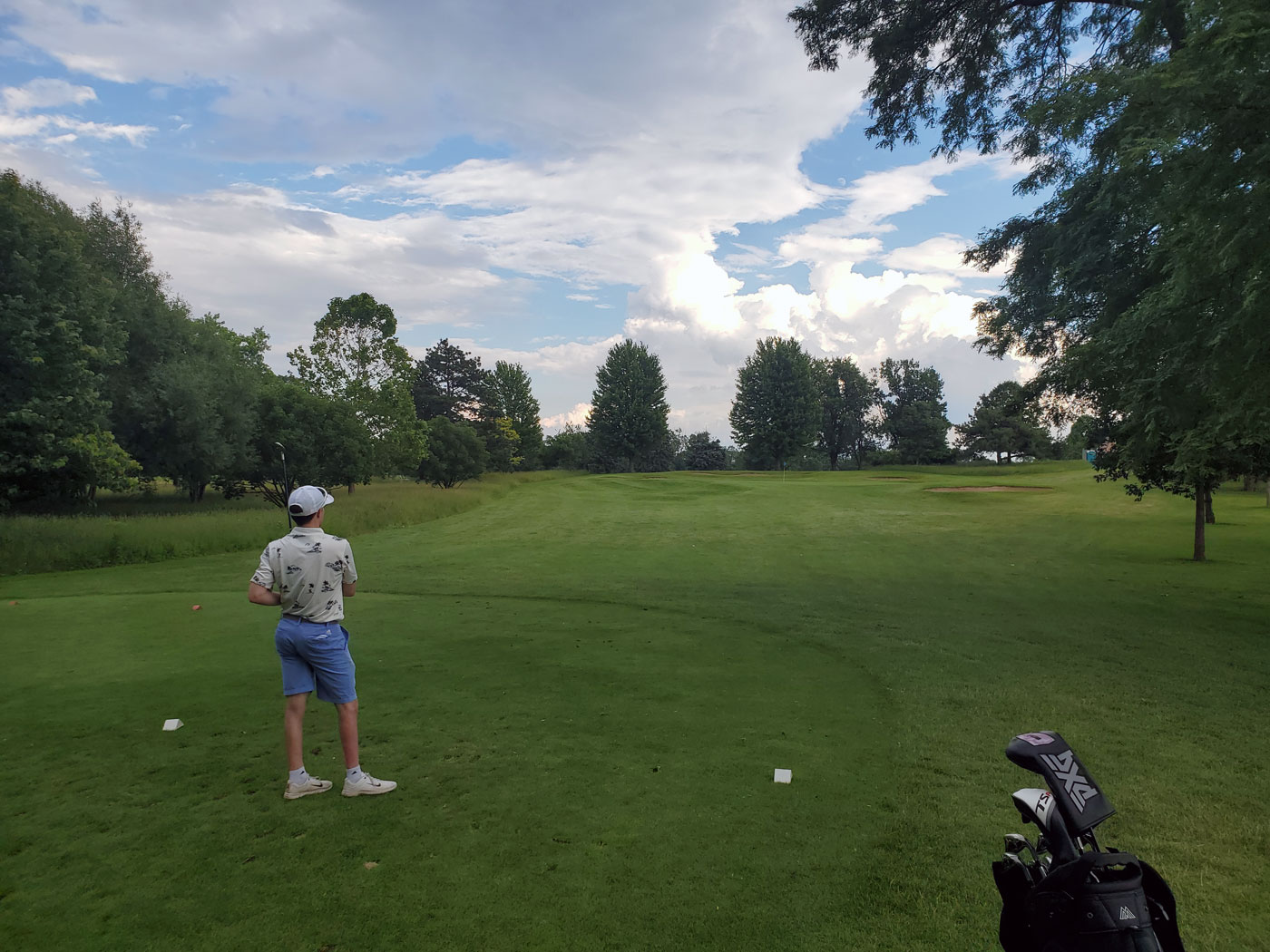
Green Meadows Golf Course – Hole 4
The Macho Man and Black Horse Golf Club
One of the more colorful connections to Black Horse Golf Club involves one of professional wrestling’s most iconic personalities. Long before he became known around the world as “Macho Man” Randy Savage, Randy Poffo grew up in nearby Downers Grove and spent much of his youth in the western suburbs of Chicago.
According to local golfers and longtime residents, Savage was known to frequent Black Horse Golf Club during its private ownership days. The compact nine-hole layout provided an easy place to enjoy a quick round, and the unpretentious atmosphere of Black Horse made it a natural fit for someone who remained deeply connected to his hometown roots despite achieving international fame.
While Savage became a legendary figure in professional wrestling through his larger-than-life personality, colorful interviews, and multiple world championships, he was also a passionate athlete whose competitive spirit extended beyond the wrestling ring. Stories of the “Macho Man” playing rounds at Black Horse have become part of the course’s local folklore, adding another layer of personality to a golf course already rich in community history.
Today, few golfers walking the fairways of Green Meadows may realize that one of professional wrestling’s greatest stars once spent time on these same grounds. Yet the connection serves as another reminder that neighborhood golf courses often become gathering places that create lasting memories and unexpected ties to notable figures in local history.
Golf for Everyone
Today, Green Meadows fills an important niche within Chicagoland golf.
Not every golfer wants — or has time — to play an 18-hole championship course.
Many players simply want a relaxed round that can be completed in about 90 minutes.
Families introducing children to golf appreciate the manageable length.
Seniors enjoy the walkable layout.
Experienced golfers frequently use the course to sharpen scoring clubs before tackling longer championship venues.
In many ways, Green Meadows represents golf at its most approachable.
Rather than intimidating players with forced carries or demanding yardages, the course invites golfers to enjoy the game.
That philosophy aligns perfectly with the Forest Preserve District’s mission of providing recreational opportunities for residents throughout DuPage County.
Preserving More Than a Golf Course
Looking back, Green Meadows’ greatest accomplishment may have little to do with golf.
Its preservation demonstrated what can happen when local governments and residents work together toward a common goal.
During an era when development permanently altered much of suburban Chicagoland, Westmont chose a different path.
Instead of allowing one more piece of open land to disappear, community leaders invested in preserving a recreational asset that continues serving residents decades later.
Thousands of golfers have since learned the game, enjoyed quick evening rounds, participated in leagues, and introduced future generations to golf on the same fairways first laid out by the Kingsfield family more than sixty years ago.
A Lasting Legacy
Green Meadows Golf Course may never host a major championship, but its importance extends well beyond tournament history.
It represents a successful community preservation effort, a commitment to affordable public golf, and a reminder that smaller courses often play an outsized role in growing the game.
More than six decades after Black Horse first welcomed golfers, Green Meadows continues to provide exactly what it always has — a friendly, accessible place where anyone can enjoy a round of golf.
In an age when many historic neighborhood golf courses have disappeared, that may be Green Meadows’ greatest achievement of all.








 Find a Golf Course
 Find a Driving Range
 Find a Topgolf
 Find a Golf Instructor