
When golfers think of Chicago’s great private clubs, names like Medinah, Butler National, Olympia Fields, and Shoreacres often come to mind. Yet one of the most remarkable stories in Chicagoland golf belongs to a much newer club—one that rose from an unlikely landscape and quickly established itself as one of the region’s most distinctive golf destinations.
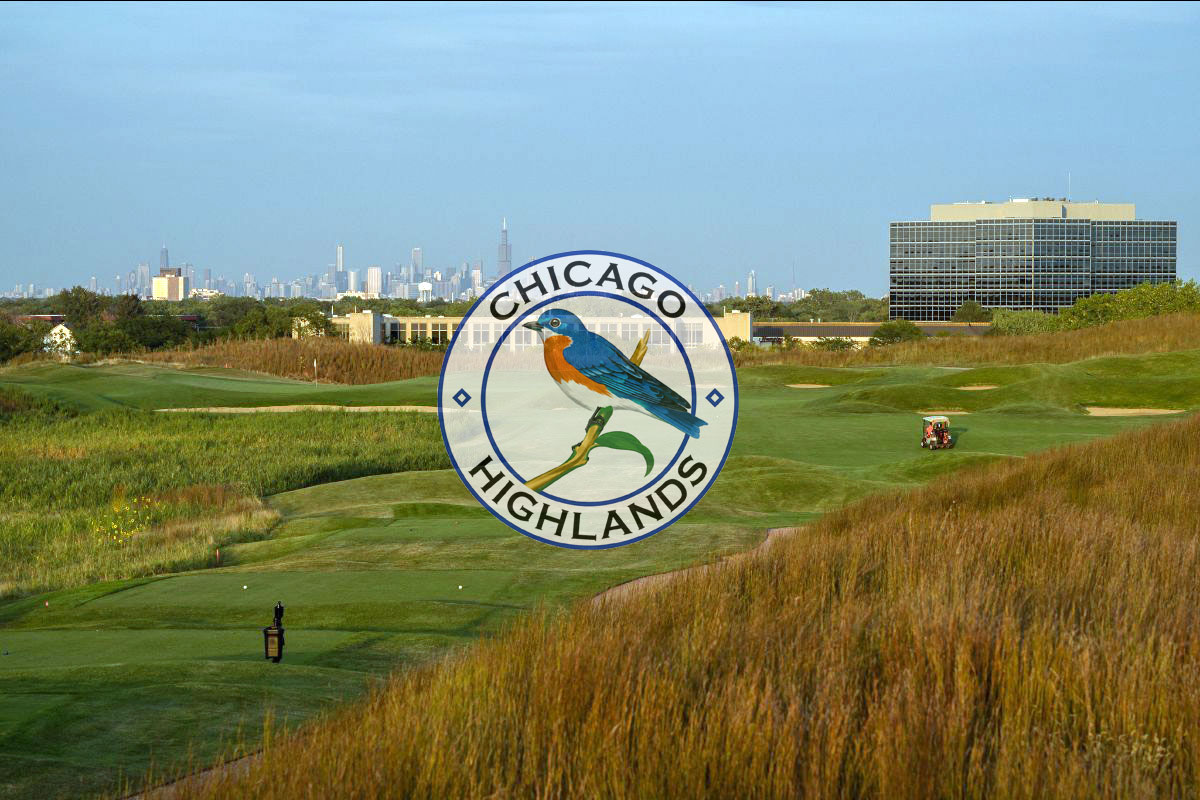
Located in Westchester, Illinois, Chicago Highlands Club represents a modern vision of private club golf. Opened in 2010, the club transformed a former landfill into a dramatic links-inspired golf course featuring nearly 100 feet of elevation change, sweeping views of the Chicago skyline, and a championship-caliber layout designed by renowned architect Arthur Hills.
A Vision Takes Shape
The origins of Chicago Highlands Club date back to 2003 when developers John Baxter, Thomas Healy, and Joseph “Joe” Hills began exploring the possibility of creating a world-class private golf club on a former landfill site near Interstate 294 and 31st Street in Westchester.
Joe Hills, the son of legendary golf course architect Arthur Hills, helped bring together a development team that saw potential where others saw limitations. At the time, the property consisted largely of flat, overgrown land that had served as one of the area’s largest landfills during the twentieth century.
Building a Golf Course from the Ground Up
Few golf courses in the Midwest required as much earthmoving as Chicago Highlands. Over several years, developers imported enormous quantities of soil and reshaped the landscape to create dramatic rolling terrain.
The project eventually generated approximately 95 feet of elevation change, an extraordinary figure for a golf course located in the Chicago area. The highest point on the property would become the site of the club’s signature ninth hole, offering panoramic views of downtown Chicago in the distance.
What had once been a flat landfill became a 270-acre golf landscape featuring sweeping fescue-covered hills, strategic bunkering, wetlands, and large undulating greens.
Delays and Determination
Early plans called for Chicago Highlands to open in 2009. In 2007, the Village of Westchester publicly promoted the project as a major economic development initiative that would beautify a prominent gateway into the community while generating significant tax revenue.
However, as was the case with many golf developments during the Great Recession, timelines shifted. The golf course officially opened for play in the spring of 2010, establishing Chicago Highlands as one of the few new private clubs to emerge during a difficult period for the golf industry.
The Arthur Hills Design
Chicago Highlands is widely regarded as one of the finest examples of Arthur Hills’ late-career work. Hills was known for creating strategic golf courses that rewarded thoughtful shot-making rather than brute force.
At Chicago Highlands, Hills created a par-72 layout stretching nearly 7,500 yards from the championship tees. Large fairways provide multiple routes to greens, while expansive putting surfaces feature significant movement and contour.
Several holes quickly gained recognition among Chicago golfers. The fourth hole, nicknamed “The Bowling Alley,” challenges players with a narrow visual corridor framed by dramatic landforms. The massive par-5 seventh stretches more than 600 yards and concludes at a sprawling green complex. The drivable par-4 fourteenth tempts aggressive players with risk-reward opportunities.
Yet it is the ninth hole that remains the club’s signature. Perched atop one of the highest points on the property, the short par 4 offers breathtaking views of the Chicago skyline.
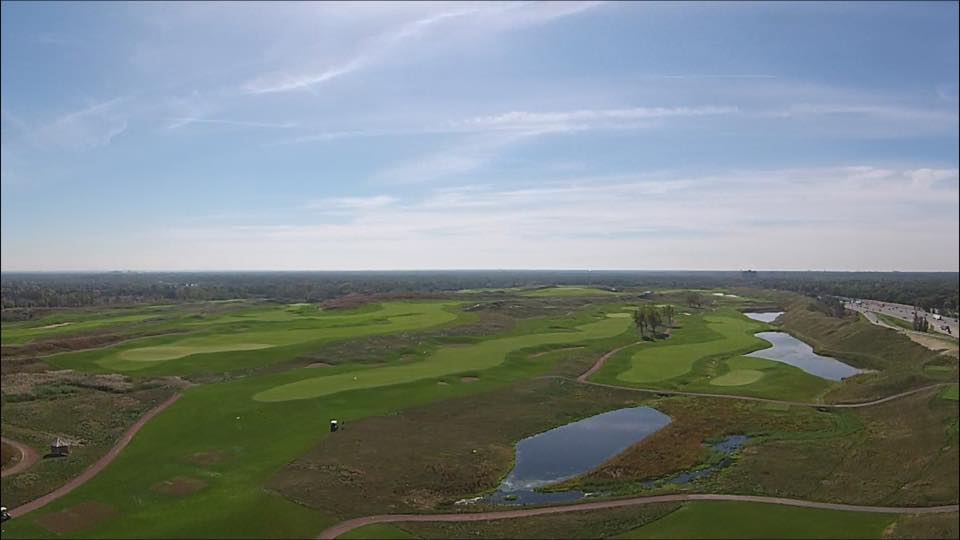
Chicago Highlands Club
Growing into a Family Club
One of the unique aspects of Chicago Highlands’ development was its phased approach. While the golf course opened in 2010, ownership delayed construction of a permanent clubhouse until membership numbers reached desired levels.
As membership expanded, Chicago Highlands evolved from a golf-focused club into a comprehensive family-oriented destination. A new clubhouse was completed just before the COVID-19 pandemic, significantly enhancing the member experience.
Additional amenities included a swimming complex, fitness center, indoor golf facilities, tennis and paddle courts, and even a four-lane bowling alley that opened in 2019.
Championship Golf Comes to Westchester
Although still relatively young compared to many Chicago-area clubs, Chicago Highlands quickly earned a reputation as a tournament venue.
The club hosted several United States Golf Association qualifiers during its first decade, including U.S. Mid-Amateur and U.S. Girls’ Junior qualifying events. These competitions demonstrated that the course possessed both the conditioning and challenge required for elite amateur golf.
Its biggest moment arrived in 2020, when the Korn Ferry Tour’s Evans Scholars Invitational was relocated from The Glen Club to Chicago Highlands during the COVID-19 pandemic.
The tournament attracted one of the strongest fields on the Korn Ferry Tour schedule, including future PGA Tour players Will Zalatoris, Davis Riley, Taylor Pendrith, and Lee Hodges. Curtis Thompson ultimately captured the title at 17-under-par, securing victory with a birdie on the final hole.
A Modern Chicago Success Story
Today, Chicago Highlands Club stands as one of the most fascinating success stories in Midwest golf.
Unlike many clubs whose histories stretch back more than a century, Chicago Highlands built its reputation from scratch. It transformed an abandoned landfill into a nationally recognized golf facility. It survived the challenges of the Great Recession. It embraced a modern family-club model while maintaining championship-caliber golf.
Perhaps most importantly, Chicago Highlands demonstrates that great golf architecture is not solely dependent on historic land or longstanding tradition. Through vision, creativity, and perseverance, the club created an entirely new landscape that feels as though it has always belonged.
In a region rich with golf history, Chicago Highlands has successfully carved out a unique place of its own—proving that sometimes the most remarkable stories are the newest ones.









 Find a Golf Course
 Find a Driving Range
 Find a Topgolf
 Find a Golf Instructor